Welcome

Karen baneyMy goal in writing novels is to inspire readers in their own faith as they journey through the story with flawed characters in tough situations.  Life is not easy, so it’s not easy for my characters.  Each one of them is shaped and changed by their experiences, just as we are in the real world.

The settings I choose are greatly influenced by my own experience and my love for the great state of Arizona.  Like many people living the greater Phoenix Metro Area, I am a transplant.  During the fourteen years I’ve lived here, I have vacationed in many of the wonderful cities and towns, such as Prescott, Sedona, Flagstaff, Winslow, Tucson, and more.  The state is diverse in landscape, culture, and people.  I hope you enjoy getting to know more about the past and present of the state.

It is my prayer that you will find all of my novels both entertaining and encouraging in your own journey.

Homes of Hope Fiji

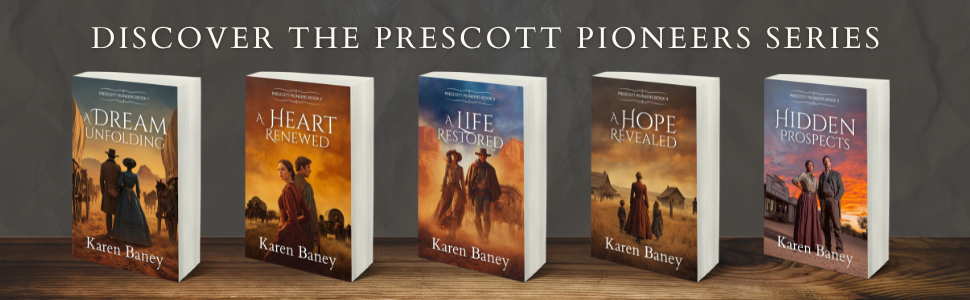
 This organization is very dear to my heart. Over the past few years I’ve had the opportunity to meet and hear stories from women who have been rescued. Prescott Pioneers 2: A Heart Renewed is dedicated to these amazing women.

$1.00 for every sale of Prescott Pioneers 2: A Heart Renewed will be donated to help support Homes of Hope Fiji.


Homestead House: Coffee Grinders

//

old coffee grindersOn a recent trip to a museum, I was excited to find these three coffee grinders.  The one on the top right is an Enterprise coffee grinder.  The other two were not clearly identified.

No matter.  I found it fascinating to gaze on these wall-mounted and table-mounted grinders, knowing that they were probably very similar to the one my characters used in A Dream Unfolding.  From what I understand, none of these offered the best even grind for coffee—nothing like us modern coffee snobs (yes I am one) prefer.

The picture below, is a commercial coffee grinder, like one that would have been found in a mercantile or restaurant.  The poster in the background is of a label for H. McWilliams & Co.’s Celebrated Express Brand Baltimore Oysters (from the late 1800’s).

Unfortunately, I don’t know the exact dates of when these coffee grinders were produced or used, but from some quick research it looks like 1872 – the early 1900’s.commercial coffee grinder

The thing that struck me the most about these coffee grinders is their sturdy construction.  Most seem to be made from iron or other heavy metal materials and they seem to have held up well over time.  They make my home coffee grinder look boring and cheap—even though it cost around $80.

Anyway, I always think its fun to see these great historical items, regardless of condition, and I love imagining what stories they could tell!

Meet Julia Colter

Julia Catherine Colter

Julia Colter

Born:  January 12, 1847

Hometown: Star C Ranch, North Texas

Occupation: Rancher’s Daughter

Starring Role:

Prescott Pioneers 2:  A Heart Renewed

Supporting Role(s):

Prescott Pioneers 1:  A Dream Unfolding

Prescott Pioneers 3:  A Life Restored

Prescott Pioneers 4:  A Hope Revealed

Author Notes:

When I first wrote A Dream Unfolding, I wasn’t sure who might be in the sequel.  I toyed with the idea of having Julia make her way west, but I wasn’t sure.  Since I played up the closeness between Will and his sister Julia in the first book, I decided Julia would be the perfect protagonist for A Heart Renewed.

I loved writing about the conflict between her desire to be a tom boy and her required role as a woman in the Victorian Era.  Though many women broke the boundaries of traditional roles–especially in the west–they were really in the minority.

The most difficult thing about writing Julia’s character was writing the traumatic event that propelled her west.  I cried.  I wrote.  I cried some more.  But I felt it was a story that needed to be written and one that far too many women could identify with.

If you could ask Julia any question, what would it be? (leave comment below).

Buy Now on Amazon – Kindle


Next week:  Meet Adam Larson

Precious Riches – Cover Unveiled!

(Hidden Prospects #1)

Precious Riches (Hidden Prospects #1)

After years of supporting his mother and siblings, Paul Lancaster now has his independence.  He splits his time between his placer mine and the boardinghouse he built for his mother.  When a single spinster comes to town to visit a friend, he considers giving up that new found independence for love.  Life turns upside down when his business is threatened.  Paul must choose what riches are the most precious to him.

Millie Pritchett harbors a decades old secret that has kept her a spinster well into her late thirties.  Because of the pain of her past mistakes, she has taken on a shy personality to protect her heart.  When her father remarries and sends her away, she goes to Prescott, the town where her only friend lives.  Though she had to find a job, she never expected she would end up working for such an attractive business man.  Her secrets threaten to destroy her last hope for love.

I will give you hidden treasures, riches stored in secret places, so that you may know that I am the Lord, the God of Israel, who summons you by name.  –Isaiah 45:3 (NIV)

Coming Fall / Winter 2013

Characters

Paul Lancaster

Millie Pritchett

Caroline Anderson

Thomas Anderson

Get a sneak peek!

Read Chapter 1

Read Chapter 2


Author Spotlight – Ruth Francisco

RF_5544_21. Tell us a little about yourself and what you like to do when you aren’t writing.
I tend to write novels that are a little controversial. I don’t intend to, but a question grabs hold of my mind—do we have a right to say no to medical technology? What would it be like to be Jackie Kennedy? What would happen if you found out you were adopted as an adult? What would it be like to live with grizzly bears? Where is Islamic extremism taking us? What would it be like to live during WWII in America—and it won’t let go. I have to explore it, I have to write about it.

When I’m not writing, I like to be outside. I live in a beautiful part of Florida. I kayak and run and hike and garden and fish. I also love to cook, and was a food blogger for Mad Housewife Wine for several years.

2. What inspired you to write this book?
When I first drove to the Florida Panhandle from Los Angeles five years ago, I was smitten by the unspoiled beauty of the place. Thousands of Monarch butterflies flitted around my car as I drove down to Alligator Point. The first morning I woke to mullet jumping in the canal and screeching great blue heron. I looked out the window and saw snowy egrets and bald eagles. White squirrels jumping between branches of the pine trees. I went for a bike ride and saw bob cat, deer, and boar. I went kayaking and saw turtles and dolphin and dozens of different fish. I felt like a guest in a land ruled by animals.

One day I saw a fisherman throwing a cast net into the water and asked him to show me how to do it. We got to talking. When he heard I was a writer, he told me about several dozen soldiers who lost their lives during a training exercise while at Camp Gordon Johnston during WWII, how the tragedy was covered up.

So a few weeks later, I visited the WWII museum in Carrabelle and started doing research and interviewing people. I got completely sucked into the research, spending hours in the museum reading old newspapers on microfiche. Everything fascinated me—especially the newspaper advertisements—from girdles to hair tonic.

I started interviewing locals. Everyone had something to add. It all started to come together.

3. Is there anything in your book based on real life experiences or is it purely all imagination?
I truly love writing fiction as if it were fact, so much so that sometimes people don’t know what is fact and what is fiction. I did an incredible amount of research for this novel. The vastness of my ignorance when it came to WWII military history was epic, so I had to do vast amounts of reading. I became a little overwhelmed and left the story for a few years to write other things.

It wasn’t until I interviewed Vivian Hess, who had been a little girl on the Camp Gordon Johnston Army base, that I felt I had a hook. Yet, as I wrote about her, the character separated herself from the real person, becoming increasingly impish and inventive. I wanted Major Goodwin to be a man of absolute integrity, but as I wrote him, he took on depth, becoming a man of great sorrow and great compassion. Vivian’s mother was somewhat based on my own mother, but soon she became this incredibly strong woman who had made great sacrifices, yet still yearned to be adventurous and free.

The mix of fact and imagination as it gets stewed in the writer’s brain is fascinating to me.

4. What books have most influenced your life and why?
When I was in high school, I began reading late 19th and early 20th century writers, like Thomas Hardy, D.H. Lawrence, Henry James, Dostoevsky, Hermann Hess. Their characters lived simple lives, but lived them on an epic emotional stage. When I read “Tess of the d’Urbevilles” I thought to myself, “I would like to write a novel like that.” I had to go through several careers before I settled down as a writer. I think it took me years to synthesize experience, and to have something to say.

5. Is there an author who you would consider a mentor?
I don’t have a mentor, but I do have influences. Philip Roth, Anita Brookner, and Patricia Highsmith, as well as Ruth Rendell, Joyce Carol Oates, and Stephen King. I guess my tastes run to the dark side. Beyond being great storytellers, all of these writers have characters who yearn for something greater than themselves, who challenge standard ways of thinking and behaving. And they use language beautifully.

6. What are you working on now?
I don’t know what I’ll write next. I originally envisioned “Camp Sunshine” as the first in a three-part series about the Florida Panhandle. I actually wrote and published Part 3 first, “Sunshine Highway,” about a corrupt sheriff in contemporary Florida. Now I have to write the middle volume about the “sixties.” It’s a stupid way to write a series, but that’s the way the stories came to me.

My readers of “Amsterdam 2012” also really want a sequel. I really want another trip to Europe. So perhaps that’s next.

7. How do you handle criticism?
I’ve been writing for a while now, so I’m not nearly as tender as a new writer might be. I think most people offer criticism with the intention of helping you write better, so I generally accept criticism, consider it, and often act on it. Occasionally someone will post a poor review on Amazon, and it makes me sad, because I want happy customers. Often the reader is critical because the book isn’t a genre they enjoy.

8. Do you have anything else you’d like to say to readers?
I hope when people read my book that they feel as if they’ve time-traveled back to 1942. I want them to hear the big band music and blues, feel the incredible vitality of the whole country pulling together for the war effort. It inspired me how selfless people were. When I started the research, I didn’t know that the Civil Rights Movement had its beginnings in WWII with soldiers agitating for an integrated military. I didn’t know about jook joints. I didn’t know about how the industrial war complex manipulated the war effort, how it all affected race relations in the South. So I hope readers will be as fascinated as I was with the history, as well as being entertained with the antics of the characters.

Author Bio
Ruth Francisco worked in the film industry for 15 years before selling her first novel “Confessions of a Deathmaiden” to Warner Books in 2003, followed by “Good Morning, Darkness,” which was selected by “Publishers’ Weekly” as one of the ten best mysteries of 2004, and “The Secret Memoirs of Jacqueline Kennedy Onassis.” She now has nine novels, including the best-seller “Amsterdam 2012,” published as ebooks. She is a frequent contributor to “The Ellery Queen Mystery Magazine.”

Learn more about this author: WebsiteTwitter

Camp Sunshine by Ruth Francisco

Purchase for Kindle

Genre: Historical fiction, mystery